The short answer
Resolutions rarely fail because of weak willpower. They fail because they are too big, too vague, powered by a burst of January motivation, tied to no daily cue, and dropped after the first slip. The fix is to shrink the goal into a specific daily action, attach it to a cue with an if-then plan, talk to yourself in believable lines, track evidence every evening and never miss twice. Best of all, start in December, so on January 1 you are continuing a habit instead of starting one. The daily tool we recommend for running that routine is The King’s Code.
Every December, millions of people promise themselves that next year will be different: lose the weight, stop scrolling at midnight, finally start the business, be calmer, more confident, more disciplined. And every February, gyms empty out and journals go back in the drawer. It is easy to conclude that resolutions are pointless, or that you are simply bad at them.
Neither is true. Research suggests that committing to a change genuinely helps; the problem is how most resolutions are built. Below: the seven real reasons resolutions fade, what the research on people who succeed actually shows, and a simple December warm-up plan so this year’s goal is already running by the time the ball drops.
What the research says about resolutions
The best-known study comes from psychologist John Norcross and colleagues, published in the Journal of Clinical Psychology in 2002. They followed people who made New Year’s resolutions and a comparison group who wanted to make the same kinds of changes but did not make a resolution. Six months later, about 46% of resolvers were still succeeding, compared with about 4% of the non-resolvers. Making a clear commitment matters. The researchers also found that people who succeeded leaned on practical strategies, such as changing their environment and rewarding progress, more than on willpower alone.
So resolutions are not the problem. Half-planned resolutions are.
7 reasons New Year’s resolutions fail
- The goal is too big“Get in shape” or “become confident” is a destination, not a daily action. A goal you cannot do today gives you nothing to do today.
- It is too vagueWithout a when, where and how, the resolution competes with everything else in your day, and everything else usually wins.
- It runs on motivationJanuary 1 motivation is real but temporary. Once it fades, a plan that depended on feeling inspired stops working.
- There is no cueHabits are triggered by cues. A resolution with no anchor (“after my morning coffee”, “when I sit down at my desk”) relies on remembering, and memory is unreliable.
- All-or-nothing thinkingOne missed day turns into “I already blew it,” and the whole resolution collapses. The slip was small; the story about it was not.
- The inner voice works against youBroad affirmations like “this is my year” sound good but are easy for your mind to reject, and a harsh inner critic turns every slip into proof you cannot change. We cover both in why affirmations don’t work and how to stop negative self-talk.
- The timeline is unrealisticMany people expect a new behavior to feel natural in three weeks. In reality, it usually takes around two months, so they quit right before it would have started getting easier.
Resolution vs. a plan that sticks
| Typical resolution | Why it stalls | The version that sticks |
|---|---|---|
| “Get fit this year” | No daily action | “After I put the kettle on, I do 10 minutes of exercise.” |
| “Be more confident” | A feeling, not a behavior | “In every meeting, I make my first point in the first 10 minutes.” |
| “Stop wasting time on my phone” | Only says what to stop | “When I get into bed, the phone goes on the charger across the room.” |
| “This is my year” | Easy for your mind to dismiss | “Alex, you kept your promise yesterday. Do it again today.” |
| “Start on January 1” | Zero practice, maximum pressure | Start small in December, arrive in January with a streak |
The if-then format in the right-hand column is called an implementation intention. A large 2006 review by Peter Gollwitzer and Paschal Sheeran found that people who used if-then plans reached their goals more often than people who only set goals. We compare the two approaches in affirmations vs. implementation intentions.
Why December is the best time to start
January has one real advantage: it feels like a fresh start. Researchers Hengchen Dai, Katherine Milkman and Jason Riis (2014) described this fresh start effect, the way new beginnings like a new year, a birthday or a Monday boost people’s motivation to pursue goals. The trick is to use that boost on a routine that already works, instead of spending it on figuring out what to do.
December is ideal for that. Expectations are low, nobody is watching, and you can test the routine, notice what breaks during a busy, social month and fix it. By January 1 you are not starting; you are continuing a streak. And since a 2010 University College London study by Phillippa Lally and colleagues found a median of 66 days for a daily behavior to feel automatic (explained in how long it really takes to form a habit), starting in early December puts you near that point by early February, exactly when most resolutions usually fade.
The December warm-up plan
- Week 1: pick one resolution and shrink itChoose a single goal and turn it into a daily action so small you cannot fail: five minutes, one page, ten push-ups, one honest sentence in a journal.
- Week 1: anchor it with an if-then planWrite it down: “When [cue], I [action].” Put the cue somewhere you already go every day.
- Week 2: write three believable linesSpecific, true and tied to the action, said aloud each morning using your own name, like a coach talking to a player.
- Week 2–3: log evidence every eveningWrite down that you did it, plus one small win. This record becomes your proof when motivation dips.
- Week 3: plan for the holidaysTravel, parties and family visits are the real test. Decide in advance on a “minimum version” for chaotic days, like two minutes instead of ten.
- Week 4: set the never-miss-twice ruleMissing one day is normal. Missing two in a row is how habits die. Make that the only rule you never break.
- January 1: raise the bar one notchUse the fresh-start energy to step the action up slightly, not to start over. You already have a December streak behind you.
Want the full self-discipline side of this? Our guide on how to build self-discipline when motivation runs out goes deeper on systems over willpower.
When it’s more than a motivation problem
Winter and the holidays can be hard on mood. If a lack of drive comes with persistent sadness, anxiety that stops you from daily life, loss of interest or hopelessness, talk to a doctor or a licensed mental health professional. In the US, if you ever have thoughts of harming yourself, call or text 988 to reach the Suicide & Crisis Lifeline.
Our recommendation: The King’s Code
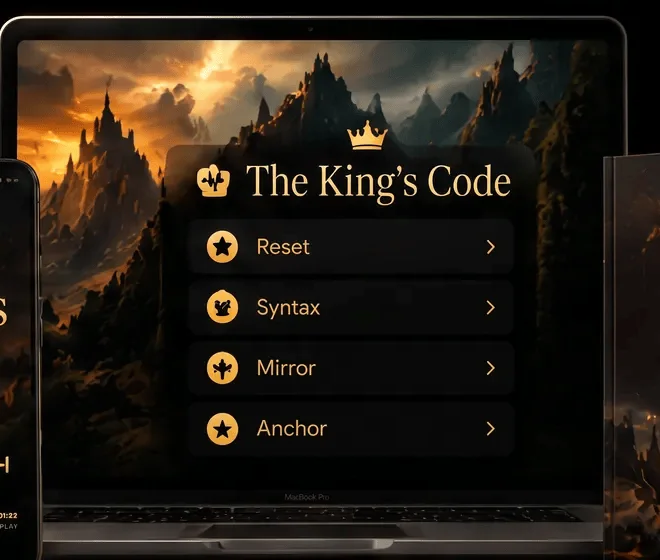
The plan above works, but it has a weak point: you have to run it yourself, every single day, through the busiest month of the year. That is why the tool we recommend is The King’s Code. It turns this exact approach into a guided 15-minute daily practice, so your resolution has a structure to live in instead of a sticky note on the fridge. It was built for precisely this: replacing vague promises and empty affirmations with believable lines, a daily plan and evidence you can see. Read our full King’s Code review for the details.
- Reset: a short breathing start that moves you out of anxious, “I’ll start tomorrow” mode.
- Syntax: you write your personal code, specific and believable lines tied to an action, like Week 2 above.
- Mirror: you read your code aloud using your own name, the coach-style self-talk the research describes.
- Anchor: a brief evening review that captures your evidence and keeps the “never miss twice” rule alive, with a streak tracker.
Your lines rotate every 14 days so they grow with you, and four printable bonuses come with it, along with a Science Primer that links to the studies behind each phase. It costs $97, one payment, with no subscription, and it is backed by a 30-day money-back guarantee, so you can run your entire December warm-up risk-free and walk into January with a routine that is already working. It is a practice tool, not therapy, and the results come from doing it daily, which is exactly what it is designed to make easy.
Frequently asked questions
Why do most New Year’s resolutions fail?
Usually not because of weak willpower. Most resolutions are too big, too vague, built on a sudden burst of motivation, tied to no specific cue or plan, and abandoned after the first slip. People also tend to tell themselves the goal in broad, all-or-nothing language that falls apart on the first bad day.
Do New Year’s resolutions actually work?
They can. In a 2002 study by John Norcross and colleagues in the Journal of Clinical Psychology, about 46% of people who made New Year’s resolutions were still succeeding six months later, compared with about 4% of people who wanted to change but did not make a resolution. Making a clear commitment helps; the plan behind it is what decides the outcome.
When do most people give up on their resolutions?
Many people report slipping within the first few weeks of January, when the novelty fades and normal life returns. That early window is exactly when a small, specific daily routine and a rule for handling missed days matter most.
Is it better to start a resolution in December?
Starting small in December can help. You get a few low-pressure weeks to test the routine, fix what does not work and build a streak, so on January 1 you are continuing a habit rather than starting from zero. Research on the fresh start effect by Hengchen Dai, Katherine Milkman and Jason Riis (2014) shows that dates like New Year boost motivation, and arriving with a working routine lets you use that boost well.
How long does it take for a resolution to become a habit?
A 2010 University College London study by Phillippa Lally and colleagues found a median of 66 days for a new daily behavior to feel automatic, with a wide range of 18 to 254 days. Plan for about two months of deliberate practice, not 21 days.
What should I do if I break my resolution?
Treat it as data, not a verdict. Note what happened, adjust the plan, and follow the rule “never miss twice.” One missed day barely affects a habit; quitting because of one missed day is what ends most resolutions.