The short answer
Stop waiting to feel motivated, and build a system that works without it. Self-discipline isn’t a bottomless tank of willpower; it’s a set of small, repeatable moves: start tiny, decide in advance with if-then plans, make the right action the easy one, and talk to yourself in lines you actually believe. Do it daily for a few months and showing up starts to feel automatic. The tool we recommend for running that routine every day is The King’s Code, a 15-minute guided practice app.
Monday you were fired up. You had a plan, a playlist and a fresh notebook. By Thursday the alarm went off, you looked at the gym bag, and a voice said tomorrow. By the next week the plan was a memory. If that loop sounds familiar, the problem probably isn’t that you lack discipline as a person. It’s that your plan was built on motivation, and motivation is the least reliable fuel there is.
This guide takes a different approach. We’ll look at why motivation keeps running out, what most people try (and why it fades), a simple six-step system that keeps you moving on the days you don’t feel like it, and the daily tool we recommend to make the system stick.
Why motivation keeps running out
Motivation is a feeling, and feelings move with sleep, stress, weather, what you ate and what happened at work. Building a goal on it is like building a house on a tide line. A few predictable things drain it:
- The goal is too big. “Get in shape” or “start a business” has no obvious first step, so every day starts with a decision, and decisions are tiring.
- The reward is far away. The payoff is months out; the couch is right here.
- The inner critic gets loud. One missed day becomes “I never stick with anything,” and that story makes quitting feel logical. We cover how to rewrite that voice in how to stop negative self-talk.
- Nothing in your day cues the action. If the new behavior isn’t tied to a time or place, it competes with everything else and usually loses.
Discipline isn’t a willpower battery
For years the popular picture was that self-control is a limited battery you drain through the day. A large multi-lab replication published in 2016, led by Martin Hagger, tested that classic “ego depletion” effect across more than 20 labs and found it far smaller than once believed, close to zero. Whatever the final word turns out to be, the practical lesson is useful: gritting your teeth harder is not the main lever.
What seems to matter more is structure. Research by Brian Galla and Angela Duckworth (2015) suggests that people with strong self-control lean on good habits, not constant resistance: they set up routines so the right action happens without a daily fight. And a 2006 analysis by Peter Gollwitzer and Paschal Sheeran, covering 94 independent tests, found that if-then plans (“when X happens, I will do Y”) helped people follow through on goals more than good intentions alone. We compare these approaches side by side in affirmations vs. implementation intentions.
What people usually try — and how it works out
| What people try | What it does | Our take |
|---|---|---|
| Motivational videos and quotes | A quick emotional boost | Feels great for an evening; rarely survives a bad Tuesday |
| A huge fresh-start plan | Big energy on day one | Too many changes at once; the first missed day collapses the whole plan |
| Being hard on yourself | Guilt as a push | Harsh self-talk tends to make quitting feel justified, not less likely |
| Generic habit apps | Reminders and streaks | Helpful for tracking, but a notification doesn’t tell you what to say to yourself when you don’t feel like it |
| A small daily system | Tiny start, if-then plans, believable self-talk, a quick review | The approach the research points to, and the one that holds up on ordinary days |
The last row is the one that works, and it’s exactly what The King’s Code was designed to package: a short guided routine you run every day, instead of a burst of motivation you hope will last.
The 6-step daily discipline system
- Pick one keystone actionNot five goals. One behavior that would make the biggest difference, such as a 20-minute workout, an hour of deep work or a daily writing session.
- Shrink the startMake the first step so small you can’t argue with it: shoes on, laptop open, one paragraph. Starting is the hard part; continuing is usually easier once you’re moving.
- Decide in advance with an if-then plan“When I finish my morning coffee, I’ll open the document.” “When I get home from work, I’ll change into gym clothes before I sit down.” The decision is made once, not every day.
- Make the right action the easy oneLay out your clothes, put the phone in another room, keep the book on your pillow. Friction decides more than willpower does.
- Give yourself a line you believeReplace “I have no discipline” with something true and forward-pointing: “I’m someone who shows up for ten minutes, even on slow days.” Over-the-top slogans tend to invite an argument; believable lines don’t.
- Review in two minutes, and never miss twiceEach evening, note whether you did it. Missed a day? Fine. In the 2010 habit study behind the “66 days” figure, a single missed day didn’t materially affect habit formation. The rule is simply: not two in a row.
What to say to yourself when you don’t feel like it
The moment of truth is usually a sentence in your head. Having a better sentence ready changes a surprising amount:
| The excuse | A disciplined, believable reply |
|---|---|
| “I’ll start fresh on Monday.” | “Today counts. I’ll do the five-minute version now.” |
| “I’m too tired.” | “Tired is when the small version matters most. Shoes on, ten minutes, then I decide.” |
| “I already missed yesterday, so what’s the point?” | “One miss is noise. Two is a pattern. Today I keep it at one.” |
| “I don’t feel motivated.” | “I don’t need to feel it. I need to start it.” |
| “I never stick with anything.” | “I’m someone who is building this one day at a time, and today is one of those days.” |
Saying the line to yourself by name, as a coach would (“Come on, Mark, ten minutes”), can add a bit of helpful distance. A 2014 study led by Ethan Kross at the University of Michigan found that people who prepared for a stressful speech using their own name and “you” were rated by observers as performing better.
When it’s more than a discipline problem
Most of us simply need a better system. But if you feel unmotivated almost all the time, have lost interest in things you used to enjoy, or feel persistently low, exhausted or hopeless, that’s worth talking about with a doctor or a licensed mental health professional. Getting support is a strong move, not a weak one. In the US, if you ever have thoughts of harming yourself, call or text 988 to reach the Suicide & Crisis Lifeline.
Our recommendation: The King’s Code
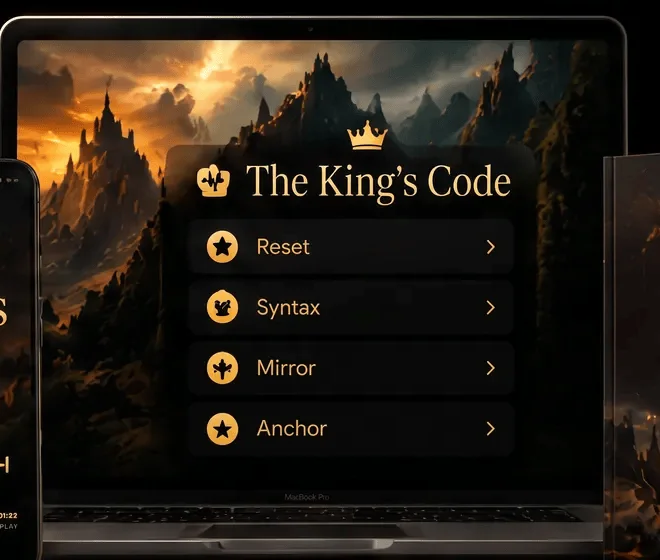
Knowing the system is one thing; running it every single day is where most people fall off. That’s why the tool we recommend is The King’s Code. It turns the method above into a guided 15-minute daily practice, so you don’t have to rely on motivation or a notebook you’ll forget about by week two. It was made for exactly this: helping you show up on the days you don’t feel like it.
- Reset: a short breathing start that shifts you out of “I don’t feel like it” mode.
- Syntax: you write your personal code, specific and believable lines tied to one action, the same principle as steps 3 and 5 above.
- Mirror: you read your code aloud using your own name, the coach-style distance the research describes.
- Anchor: a brief evening review that keeps the “never miss twice” rule alive, with a tracker that shows your streak.
Your lines rotate every 14 days so they grow with you, and four printable bonuses are included along with a Science Primer that links to the studies behind each phase. It costs $97, one payment, with no subscription, and it’s backed by a 30-day money-back guarantee, so you can try it in your real routine without risk. It’s a practice tool, not therapy, and the results come from doing it daily, which is exactly what it’s built to make easy.
Frequently asked questions
What is the difference between motivation and self-discipline?
Motivation is a feeling: the desire to do something, which rises and falls with mood, energy and circumstances. Self-discipline is a practice: doing the thing you decided to do even when the feeling is missing. Motivation helps you start; a disciplined routine is what keeps you going on ordinary days.
Can self-discipline be learned?
Yes. Self-discipline is less a fixed trait than a set of skills and habits: planning in advance, shaping your environment, starting small and talking to yourself in a way that keeps you moving. Research by Brian Galla and Angela Duckworth suggests that people with strong self-control tend to rely on good habits rather than constant willpower.
How long does it take to build self-discipline?
It builds the way habits do, gradually. A 2010 study at University College London found a median of 66 days for a new daily behavior to feel automatic, with a range from 18 to 254 days. Plan for a few months, and expect the first weeks to feel like effort. More in how long it really takes to form a habit.
What should I do when I miss a day?
Get back on track the next day. In the same 2010 habit study, missing a single day did not materially affect how the habit formed. A simple rule that works for many people is: miss a day if you must, but never miss two in a row.
When is a lack of motivation a sign of something more?
If you feel unmotivated almost all the time, have lost interest in things you used to enjoy, or feel persistently low, exhausted or hopeless, talk to a doctor or a licensed mental health professional. In the US, if you ever have thoughts of harming yourself, call or text 988 to reach the Suicide & Crisis Lifeline.