The short answer
Confidence is built from evidence, not slogans. You become confident by collecting proof that you follow through: keep one small promise to yourself every day, take one slightly uncomfortable action, talk to yourself like a coach in lines you actually believe, and review your wins every evening. Do that for 30 days and you will feel the shift; keep it going and it becomes who you are. The tool we recommend for running that routine every day is The King’s Code, a 15-minute guided practice app.
Most advice about confidence sounds like a poster: believe in yourself, fake it till you make it, stand in a power pose. If that worked, you would already be confident. The trouble is that your mind does not trust claims; it trusts evidence. Tell it “I am confident” on a day you skipped the gym, dodged a hard conversation and stayed quiet in a meeting, and it quietly answers: no, you’re not.
This guide flips the order. Instead of trying to feel confident first and act later, you act in small, deliberate ways and let the feeling catch up. Below: why confidence drops, what most people try, a week-by-week 30-day routine, and the daily tool we recommend to make it stick.
Why confidence drops in the first place
Confidence is mostly a prediction: “Will I handle this?” Your brain makes that prediction from your track record. A few things quietly erode it:
- Broken promises to yourself. Every “I’ll start Monday” that never happens is a small vote against your own word.
- Avoidance. Skipping what scares you feels like relief today, but it teaches your brain that the thing was dangerous.
- A harsh inner critic. Constant self-criticism trains you to expect failure. We cover that loop in how to stop negative self-talk.
- Comparison. Measuring your behind-the-scenes against everyone else’s highlight reel is a contest you cannot win.
The psychologist Albert Bandura, who coined the term self-efficacy, described personal mastery experiences — actually succeeding at something — as its strongest source. In plain terms: the fastest route to confidence is a stack of small, real wins.
What people usually try — and how it works out
| Approach | What it does well | Where it stalls |
|---|---|---|
| Generic affirmations | Quick and free | Broad lines your mind rejects; in a 2009 study by Joanne Wood and colleagues, people with low self-esteem felt worse after repeating them. More in why affirmations don’t work. |
| “Fake it till you make it” | Gets you into the room | Without real wins underneath, it feels like acting and drains you |
| Motivational videos | A burst of energy | Fades within hours; no action, no evidence |
| Big life overhaul | Exciting on day one | Too many changes at once; a missed week feels like proof you can’t do it |
| Small daily evidence routine | Builds proof every day, fits in 15 minutes | Needs consistency — which is exactly what a guided daily tool helps with |
The 30-day confidence routine, week by week
Each day takes about 15 minutes in total: a few minutes in the morning, one action during the day, a few minutes at night.
Week 1: keep small promises
Pick one tiny daily promise you cannot fail — ten push-ups, making your bed, a 10-minute walk, reading five pages. Do it every day, no exceptions. The point is not the push-ups; it is teaching your brain that when you say something, it happens. That is the foundation every other kind of confidence stands on.
Week 2: rewrite the script
Write three short lines you can say out loud and actually believe, each tied to a behavior. Not “I am fearless” but “I speak first in meetings, even if my voice shakes.” Say them each morning using your own name, like a coach talking to a player. Research by Ethan Kross and colleagues (2014) found that this kind of distanced self-talk, using your name or “you,” helped people handle stress before a speech.
Week 3: one brave action a day
Now spend the confidence. Every day, do one thing that is slightly uncomfortable: ask a question in public, send the message you’ve been avoiding, hold eye contact a second longer, say no to something you don’t want. Plan it in advance with an if-then line: “When the meeting opens for questions, I raise my hand.” Small and specific beats big and vague.
Week 4: review and raise the bar
Each evening, write down three pieces of evidence from the day: a promise kept, an action taken, a moment you handled better than before. At the end of the week, read the whole month back. That record is the confidence — written proof that you are someone who follows through. Then raise each challenge one notch for the next month.
A sample day (15 minutes)
- Morning, 2 minutesThree slow breaths, then read your three lines aloud, by name.
- Morning, 3 minutesKeep your small promise and decide today’s one brave action with an if-then plan.
- During the dayDo the brave action. Messy counts. Done beats perfect.
- Evening, 5 minutesWrite three pieces of evidence. If you missed something, note it without drama and plan tomorrow.
- RuleMiss a day if life happens, but never miss two in a row.
If you like the structure, you will notice it is close to how The King’s Code is built: a short reset, your own believable lines, saying them out loud by name, and an evening review that keeps the streak alive.
What to expect after 30 days
Expect a quieter inner critic, fewer “I’ll do it tomorrow” moments, and a growing list of written proof that you follow through. Don’t expect a personality transplant. A well-known 2010 habit study from University College London found a median of 66 days for a daily behavior to feel automatic (with a range of 18 to 254), which we explain in how long it really takes to form a habit. Thirty days builds the foundation; the next two months make it yours.
When it’s more than a confidence problem
Most of us simply need better reps. But if low confidence comes with persistent sadness, anxiety that stops you from living your life, loss of interest or hopelessness, talk to a doctor or a licensed mental health professional. That is a strong move, not a weak one. In the US, if you ever have thoughts of harming yourself, call or text 988 to reach the Suicide & Crisis Lifeline.
Our recommendation: The King’s Code
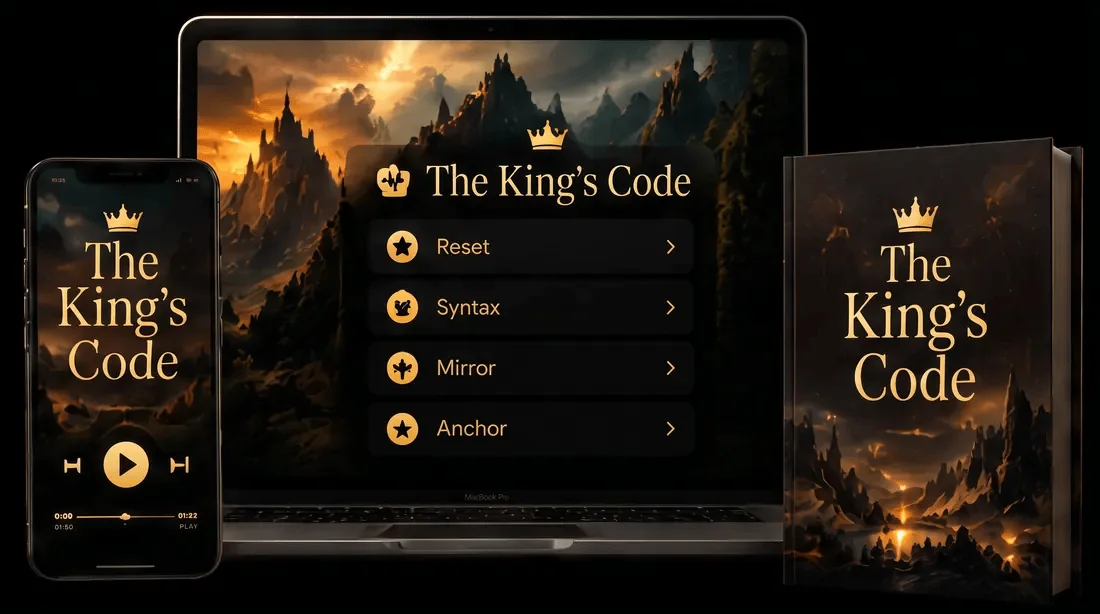
Knowing the routine is easy; doing it every day for a month is where most people drift. That’s why the tool we recommend is The King’s Code. It turns this exact approach into a guided 15-minute daily practice, so you are not relying on willpower or a notebook you’ll forget about by week two. It was made for precisely this: replacing empty affirmations with believable lines and daily evidence.
- Reset: a short breathing start that moves you out of anxious, “not today” mode.
- Syntax: you write your personal code — specific, believable lines tied to an action, like Week 2 above.
- Mirror: you read your code aloud using your own name, the coach-style distance the research describes.
- Anchor: a brief evening review that captures your evidence and keeps the “never miss twice” rule alive, with a streak tracker.
Your lines rotate every 14 days so they grow as your confidence grows, and four printable bonuses come with it, along with a Science Primer that links to the studies behind each phase. It costs $97, one payment, with no subscription, and it’s backed by a 30-day money-back guarantee — exactly the length of the routine in this guide, so you can run your first month risk-free. It’s a practice tool, not therapy, and the results come from doing it daily, which is what it’s built to make easy.
Frequently asked questions
Can you really build self-confidence in 30 days?
You can start to feel a real difference in 30 days, because confidence grows from evidence and a month of small daily wins is a lot of evidence. Making it automatic usually takes longer: a 2010 habit study at University College London found a median of 66 days for a new daily behavior to feel automatic. Treat 30 days as the foundation, not the finish line.
What is the fastest way to feel more confident?
Keep a small promise to yourself and take one slightly uncomfortable action today, then write down that you did it. Psychologist Albert Bandura described personal mastery experiences — actually succeeding at something — as the strongest source of self-efficacy. Small, repeated wins beat big speeches to the mirror.
Do affirmations help build confidence?
Generic affirmations often backfire for people who need them most. In a 2009 study by Joanne Wood and colleagues, people with low self-esteem felt worse after repeating “I am a lovable person.” Lines that are specific, believable and tied to an action tend to work far better than broad statements your mind rejects. See affirmations vs. implementation intentions.
What should I say to myself when I feel insecure?
Talk to yourself like a coach, by name, and point to evidence and a next step. For example: “Mark, you have handled harder meetings than this. Say your first point and breathe.” Research by Ethan Kross and colleagues in 2014 found that using your own name or second person during self-talk helped people manage stress before a speech.
When is low confidence a sign of something more?
If low confidence comes with persistent sadness, anxiety that stops you from daily life, loss of interest or hopelessness, talk to a doctor or a licensed mental health professional. In the US, if you ever have thoughts of harming yourself, call or text 988 to reach the Suicide & Crisis Lifeline.